Wednesday, 24 April 2013

One twenty? No, one 'twenty'

                                                      
That's how you bargain at Chinatown and Downtown in Kuala Lumpur. The term 'Downtown' might be misleading, it usually refers to the posh areas in top cities. However the 'Downtown' here as it is referred to by locals, offers roadside shopping.
There are three rules to be followed while shopping in these places.
1 .Bargain
2. Bargain more
3. Bargain even more.
Both markets have almost every possible purchasable item known. They draw their own crowd. Shops aren't usually exclusive for one item. There are hundreds of competitors in the same market. Don't write them off, these people are professional in their own way, they are efficient entrepreneurs. They know what works in their business. For instance, just as it began to pour, as I started running to my car, calling out to me was a shopkeeper, "Umbrella for 20 MR. Bargain-able!", the interesting fact being the shopkeeper saying that he is open to a bargain even before the customer reacts.

Chinatown is the Malaysian home for 'Made in China' goods. One doesn't need an explanation for what holds in store there. It is the workplace of hundreds of vendors (who smoke as they work). "Now beware of the sellers here" a local friend of mine had warned. The sellers take to the knife if a purchase is not made after a long bargain!

Downtown offers a comparable experience in a slightly different way. It is a good example of the night life prevailing there. Shops open around 8 in the night and go on till 3 or 4 the next morning depending on the crowd. Couples walk in hand in hand at midnight.  The vendors here mostly work part time. Shops are set up in identical tents but they are distinct on the inside. These vendors are comparitively less aggressive, they don't hide knives.


"Each purchase is an act of mutual understanding between the customer and the vendor. The vendor clearly knows that he over-quotes his item, so does the customer realise that. The initial rates are similar to the ones quoted by Tamil Nadu auto-men to foreign tourists. Exorbitant."

In Chinatown, calculators break the language barrier. Conversations with vendors bear only numbers. A calculator can help accomplish that. So this is how you go, you first point at the desired item. The vendor types in a number (his initial quote in Ringgits) on the calculator and hovers his hand over the 'minus symbol' suggesting a prospective bargain, a definite bargain. You press the minus symbol and make the desired reduction in rate. If my observation is anything to go by, typical bargains end somewhere lesser than midway between the customer and the vendor, the consumer being on the left. This is how an unsuccessful bargain went,
"Black bag" <pointing at it>
"That will be 120MR madam." <'madam' being my mother>
"No, one 'twenty'"
"No madam" <nods no and performs a calculation on the calculator 120-35=85> .
<End of conversation>

At the Downtown, bargaining is not an easy task. The old lady at the 'bag store' was headstrong about the 'green bag' costing 30 MR. There was no room for bargain because the bag was 'water proof and made of 100% leather'. She was generous enough to reduce 5MR each for the other bags we purchased.
It is just the place for ladies crazy about shopping. The shops offer highly fashionable stuff in 'striking colours' as preferred by the locals there.
There are the restaurants that stay open till 3am. There are no competitors here, each restaurant offers a specific food item. There is no menu card, the only item available is clearly identifiable. It is hard for a vegetarian to get stuff to eat in there. He/She could get a cup of  'cut guava' for 2MR, and get more to make a meal. Then there are these shops that sell electronic goods. These goods are packed to perfection, replicating the original packaging. 'Beats Audio' for 15MR! No wonder most music-listeners in the city sport one of them.

Chinatown is the more popular of the two, drawing more foreign customers. Downtown is more restricted to the locals. Nevertheless both these places offer distinct yet enjoyable shopping experiences! So don't forget the extra bag when you plan a trip to KL, for it is sure to become full. Happy shopping!
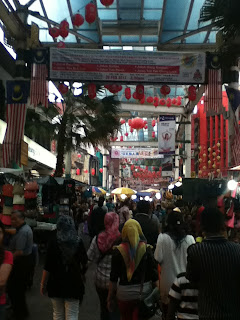
The crowded streets in Chinatown
The tents in Downtown, closed in the day


Friday, 12 April 2013

No Parking!

#3
The incident described in this article happened a few months ago, when we had dropped by at a relative's place. The place located in a narrow street in Mylapore, had no room for cars to be parked. Parking the car contiguous to the street was ritualistic until then.

An hour after the car was parked, it was missing. The car had either disappeared or been towed by the police, the latter being much more probable. Being my sister's month old car, she was startled. The 'guy at the iron shop' had closed for lunch for the hour and had no clue where the car was. I wasn't shocked, unlike my sister. For me, it was partially exciting for I knew it was a game with the police. And so, we enquired among people who could have seen the car being taken away, no one had any idea. Common sense suggested we could enquire at the nearest police station and so, I along with my father and sister, in my dad's car drove to the Mylapore police station.

'The officer at the entrance' showed us in. The men there were dispersing for lunch and lead us to the Traffic Police department in the first floor. The sight of the first floor left my sister in a daze for it shared a striking similarity to a men's changing room , there was only one police constable in that floor and he was busy with his lunch. As we walked back down, the 'officer at the entrance' suggested we go check at the beach or at the next nearest police station. The next nearest was by my place. And so we drove to the Abhiramapuram police station. The officers there were done with lunch, and they listened to my father with interest. "My car was parked by the street around 11 and .....". They seemed like the better officers at that moment. They suggested we call the control room, and gave us the number. The line was busy.

And there we stood, right before the police station having no idea where the brand new car had been taken. It was not parked in a 'No Parking' zone.  Moreover, it wasn't the idea of the second to park it at that spot. Highly frustrated but keeping his cool was my dad. Just as we decided to go to the beach to look for the car, an attempt to reach the control room succeeded. My sister explained solicitously to the 'officer on the line', "It wasn't parked in a No Parking zone, it is a brand new car". Calling back after five minutes, the 'officer on the line' confirmed that a car towed matching the mentioned description had been taken to the beach or The Music Academy junction.

The MA was the next spot. From a distance, my sister spotted her car parked under the flyover next to the towing van and a traffic police officer. Parking the car haphazardly, my father, and sister got off the car. I used the opportunity to enhance my parking skills and parked the car better.

Frustrated and heaving a sigh of relief at the sight of her car, she interrogated 'the officer' why her car had been towed. "The Governor had to pass by the road". That was the answer. Disgusted by the hasty response, my dad asked why there was no information left about where the car was being taken. He wanted answers for the hour we had just spent in agony. "Governor varam bodhu car ah nirithna apdi dhan pannuvom" were the words of reply.  The calm was lost. My dad wanted legitimate answers. After a few heated exchanges, the police officer fetched the key, didn't unlock the wheel yet. He had just taken his billing machine out. Demanding a fine of 500 from us, he carried on billing. My father stopped him from doing so. He wasn't ready to pay the fine, not for the amount, but because there was no wrong on our side. When asked what the fine was for, he replied it was for the car being parked on the road when the Governor passed by. When we argued it wasn't a 'No Parking' zone, he hastily said it wasn't a Parking Zone. Looks like there is something that we have all missed between Parking and No Parking.
This led me to these inferences : Never park your car in a place that does not have a 'Parking' sign. Paste your personal contact details on the windshield of the car to make it easier for the police to reach you. (sarcastic suggestion by the officer)

Balked at the purpose of the fine, my father refused, 'the officer' contemptuously replied he wouldn't release the car. The disrespectful comments infuriated me. I decided to take help from my 'influential friend'. I knew I wasn't taking advantage for there was no wrongdoing on my side and for we had been treated crudely. I remember shrieking at one of the police officer's harsh remarks before I decided to take it to my friend. The 'influential friend' was quick to respond. All he wanted to know was the name of the police officer. I could see my father succumbing to the officer's demands as I was on the line, I shouted from a distance asking him to wait. I didn't want it to be an episode where the police officer had his way even when he was on the wrong side.
The officer threatened to move the car to the beach if the fine wasn't paid immediately.
It all had to happen at the same moment, as my father drew currency notes out of his wallet (to pay the fine), as the policeman re-towed the car, came a phone call. 'The officer' responded with respect on the line. It was from an authoritative person. I do not take pride in saying this, again, I hadn't taken advantage of my friend's resources.
It is stupefying what a phone call can do. The police officer, who showed no signs of respect until then unlocked the wheel and had just three words to say and I quote "Kavalthurai Ungal Nanban".

Had the 'infuential friend' not been there, we would have had to accede to the police officer. This is not thanking the friend. "Why did my car which was parked very much in the corner have to be moved for the Governor to pass by?, Why did the officer show such baffling disrespect?, Why were we asked to pay a fine!" are the unanswered questions.
British prime minister David Cameron took to the Metro Rail after a speech of his a few years back, while the Governor here requires a convoy and the road to be cleared to make it through the way. The police officer was definitely not a friend as he had claimed.
Thoughts about our country being a politically bad one flooded me that day. I respect policemen, it would be wrong to judge them with one incident.
Unwilling to indulge in any further exchange with the police officer, we returned to the relative's place for the special lunch.