Showing posts with label General. Show all posts

Wednesday, 27 April 2016

Chaos and You

Ajith's solution to move the auto
While this popular comedy sequence from Tamil movie Attagasam (see image) may have been written in an attempt to create a mindlessly hilarious scene, it is also possible that the writer was hinting at Ajith's mathematical genius by demonstrating his ability to solve problems in chaotic systems. Popular American mathematician and pioneer of Chaos Theory, Dr. Edward Lorenz, in 1972 presented his work titled "Does a flap of a butterfly's wings in Brazil set off a tornado in Texas?". Well, "Could a change in the position of a rear view mirror affect the movement of an auto?" sounds less imaginative, right? 

If you are a watcher of Tamil films, understanding this scene could be the best possible introduction you could get to Chaos Theory. Take the gag where Ajith and co pull the auto from behind off. Now, it is possible that the movement of the mirror triggered disturbances of air particles next to it at the molecular level, effects of which further magnified at the engine intake valve and caused the vehicle to move. Yes, that's a terrible explanation, but a possible one. We're talking about sensitivity to initial conditions - how your bad throat caused a receptionist to lose her job, how the blink of your eye caused the power to go off, how Dhoni's run out ruined a dish in a Californian household, how the cake tasted salty because you used salt instead of sugar (okay, not as chaotic).

There's a trick speakers about Chaos Theory use - begin by making an exaggerated claim just like the pioneer himself did and later, explain how the world works this way using fairly straightforward Lorenz equations. At the receiving end, you are not amazed, you are confused, but you wonder at the immensity of possibilities that any given situation puts forward. If you are intrigued by the theory as I certainly am, you would want to know how it affects you and why these crazy claims are true.

When Dr. Edward Lorenz first described Chaos Theory at a conference, he was quick to address the drama in the title. The title, if not understood in proper context could cause misunderstanding, he remarked. In the situation described by Lorenz, he provided evidence for his claim about the flaps of a butterfly's wings in Brazil causing a Tornado in Texas several years later. The context included the presence of a countless number of other such factors during this time interval. Words spoken, words not spoken, stones thrown, flights flown, cars driven, cats running are all factors as equally likely (forgive me if this is a mathematically inaccurate claim) to cause the tornado. In short, we are in a chaotic system.  But we perceive order in this chaos, don't we? The chaos that you are in doesn't stop you from reading further, does it? And that means order exists, right? Part of this understanding lies in the fact that chaos and order are not enemies but opposites, as remarked by Richard Gariott. They're not trying to kill each other but can co-exist depending on the context.  

As Constance Kaplan, a psychotherapist who specializes on Chaos Theory in psychology said, "How we deal with it is who we are". It is this very aspect that lets us perceive order as a human being in a chaotic surrounding. The realization of the significance of self worth, faith and belief in oneself as factors influencing the outcome of situations that matter to us is the missing card, the variable that matters the most. Dhoni, in his press conference post the match against Bangladesh in the World T20 tournament remarked about "managing chaos" in the middle. His presence was perhaps the most significant variable and hence, the most likely to establish order (victory) from the chaos he was present in.


Here are a few useful links if you are intrigued.

https://www.youtube.com/watch?v=ettre2Uz6bs
https://www.youtube.com/watch?v=EF5Wvi_Iiy4
https://www.youtube.com/watch?v=FfBRwjEkcVQ


Sunday, 14 June 2015

The Untold Story

I need to tell you right away that I do not know what the untold story is. Nevertheless, I am certain there is one. Ever since the varicella zoster virus crept into me, I've been confined in my room. It is a highly contagious virus; leaving me with no option but to room-arrest myself. 'Arrest' can be misleading here; I do not wrap myself up in a blanket and lay on the bed all day. It is in fact quite a holiday; I've had everything I want, food is being brought to my room and the virus doesn't give me much trouble.
If you're wondering what I'm talking about, I've taken inspiration from Tamil cinema; the first scene in a movie is an important one and very relevant to the story. What follows immediately might or might not always contribute to the story in any manner, but they're still there. Now, we cut back to the story.

I've been watching a lot of news on the TV due to the illness and a major part of it over the past few days has been about the much talked about Maggi row. It did not come across as a matter of surprise to me initially when it was found to contain harmful levels of certain chemicals; people had earlier advised me against it and called it cancerous. Nevertheless, no other product in the market can substitute for the "quick food" that Maggi has been over all these years and I never stopped buying it. It is also also the only 'eatable' which most of us can cook while making it taste as good as anyone else's.
However, the FSSAI  decided to pull the plugs off the product and call it 'harmful'. News channels were quick to do their job - Mr. Goswami certainly did, in high-decibel fashion with his panel of food experts. In fact, they did their job so well that the brand's reputation was taken down in a matter of days and the global CEO of Nestle took the next flight to India.
What exactly is the issue? The amount of lead content in Maggi has been found to be higher than the allowable limit established by the FSSAI, higher by 17 times! The presence of lead is not indicated in the list of ingredients on the package. Some authorities find MSG in it, an ingredient that is not mentioned. A few of them say that the problem is restricted to March 2014 batches, products of which should have expired by now; but a few states have banned the product based on tests on current batches. The list goes on.

As a consumer, before all of us are exposed to more technicalities on ingredients and become degree holders in food science, let us try to put things in perspective and try to stay away from the manipulative nature of the media. The first question that logically follows is 'The product is found to be harmful for consumption, exceeding limits by alarming amounts. Why is it news all of a sudden? How was the product approved in the first place?'. This is the question that has remained unanswered. In one of the debates on the issue, a BJP spokesperson pointed out that the FSSAI is to be blamed for the delay in identifying the harms of the product and that it is only a matter of time before such products are being taken off shelves. It is important to note the 'delay' she is referring to. I cannot recollect when I started consuming Maggi, it has been very long since I did; the 'delay' referred to here, is at least one of ten years in that case. Thus, it is possible that you and I have been consuming a product that has been harmful, for over a decade without our authorities 'identifying' the harm.
Another debate points out that the tastemaker and the noodle cake have to be treated as one and not separate entities according to international standards. As consumers, we just don't need to know testing procedures and it is not for the household to debate about. All we need to know is whether a certain product is safe or not, and hence, the government run FSSAI; in them, we trust.

A lot of other products is under the scanner too. One of the news reporters barged into a Starbucks store to report that four of their coffee varieties and seasonings have been found to violate regulations. Eight out of twelve other noodle products have been found to contain higher amounts of lead. This 'sudden' awareness is baffling, from a consumer point of view.
The media calls this a 'wake up call' for our authorities. The news that we've been exposed to contains more than required levels of chemistry. What the consumer needs to know is what remains untold. The untold story is one which would answer the following questions - Is it safe for me to consume all products that are available at the market? If not, what is the kind and amount of discretion that I, as a consumer, should enforce? And finally, are the authorities even doing their job of ensuring safety in food products? The answer to all these questions would expose what has gone wrong, who is responsible and what the preventive measures are. At the moment, the chemistry is not doing the job.

Saturday, 17 January 2015

Art Beyond Social Barriers

Breaking social barriers, bridging the gap between the rich and the poor and ensuring equality are never ending pursuits. The power of art in achieving such visions is often underrated, or rather not understood by all. The reason lies in the fact that art forms do not discriminate, they can add beauty to anyone's life. It is thus significant that this trait of an art form is preserved. This is what the Urur Olcott Margazhi Vizha has tried to do.

Over the past years, along with the growing social divisions, practice of art forms has divided. This has resulted in an instinctive branding of some forms of art as 'superior'. Though the 'superiority' isn't openly discussed about, it has had its effect in practice. Mr. T M Krishna's brainchild, the Urur Olcott Margazhi Vizha stems out from the vision that this 'superiority' doesn't exist by nature and that art belongs to all.

It is common observation that most of the listeners in Carnatic concerts today are members of the same caste and belong to particular areas of the city. While no restriction is placed on the kind of the audience, due to various reasons, certain art forms such as Carnatic music remain either unapproachable or inaccessible or both to certain sections of the society. This maybe due to social, economic or even discriminatory reasons. In simpler words, it is almost impossible to find a resident of the Urur Olcott Kuppam (the Urur Olcott slum) in a concert hall during the Margazhi Vizha (the December music season).
When I came across the initiative on Facebook, I was pleasantly surprised. Initially, I felt it would pass by unnoticed. The bad weather in December was probably a blessing in disguise which resulted in the event being postponed to the Pongal time and gathering the much needed publicity in this period.

An overwhelming crowd; abandoned vehicles used as decorative elements
I had managed to make myself present on the second day of the festival just as I had promised myself. From the first sight of it, it seemed like a grand success. The crowd was much more than I had imagined; the decorations, beautifully done. Right in front of the stage (not seen in the picture), was a group of enthusiastic children from the slum. The graffiti work on the walls was nicely done and would leave the people of the slum with memories they would cherish. Having attended Carnatic concerts in various halls, to watch Mr. Unnikrishnan perform in the backdrop of the sea and in the slum, was a completely new experience for me and many others who were present.

Locals watching from their houses
The idea is revolutionary. However, the success of the implementation is questionable. The viewers/listeners from outside clearly outnumbered the locals present. Also, the notion that it takes a certain pre requisite knowledge to enjoy a classical art form kept a few locals away. This was evident when a group of boys sitting right in front of me chose to leave after their request for a gana song wasn't heeded to by Mr. Unnikrishnan!

Many locals did seem to enjoy the festival too. The old man beside me was all smiles throughout the concert and expressed his joy in a very animated manner. Some watched from their houses and seemed visually pleased. Many girl children clad in saree were all dressed up for the occasion and posed for photographs; they sure were made to feel important.


(Click image)
Another objective of the festival was to bring classical and folk art forms to the same stage. The concert was followed by a drama presentation by members of the slum. The lead actors put up tremendous performances. The kid on the harmonium was simply brilliant and definitely rose some eyebrows. The amount of talent in ONE slum area is truly surprising to say the least.
Such talent is largely unnoticed and the artists made good use of this opportunity.


The festival was a learning experience. Art forms need to break social divisions and be accessible to all. Carnatic music has to reach the slum people just as much as folk art forms have to reach the city. Just as the drama was about to end, Mr. T M Krishna walked in silently and sat down to watch the performance. He has succeeded in making this a festival for the slum people sans any sort of personal branding.

This guy on the harmonium was brilliant

Managed to get a picture with Mr. T M Krishna!


Wednesday, 10 December 2014

'Our' Music

The word Margazhi does ring a bell to most of us and we tend to associate it with Carnatic music. This music festival draws much global attention and brands Chennai as the hub of Carnatic music which is a matter of great pride. Thousands of fans fly across borders to witness the biggest music festival of the country; yet, many locals are caught oblivious. The first step to enlighten the unaware would be to shatter all the misconceptions that surround Carnatic music.

Devotional music and Carnatic music differ from each other. Devotional music involves singing in praise of god. In Carnatic music, while there are songs with references to various Hindu gods, there are a large number of songs without such references. Hence, the association of 'sacred' or 'spiritual' with Carnatic music is not direct. In fact, most Varnams (songs usually sung in the beginning of a concert and seen as 'warm up' songs) have erotic meanings which is surprising because we learn most of these songs as kids.

It is common notion that Carnatic music, or any other classical art form for that matter, is not modern. If modern means aping the west (as many of us seem to intrinsically conceive it), the notion is right. However, the truth remains that this art form has evolved with time (notably even since I started learning it) and is completely 'modern' when seen from an unbiased perspective. Those who disagree would be surprised when they come to know about the likes of Mr. T M Krishna and many other current day musicians. 

The listenership of Carnatic music isn't highly limited as many seem to believe. To get tickets for concerts of top musicians is as hard as getting a ticket for Lingaa on the day of its release. For a typical evening concert featuring top performers, the crowd in most known sabhas is overwhelming, each time. Listeners who fail to get proper seats find their place on the stage surrounding the performers or on the stairs. 

Carnatic music isn't restricted to the grey haired. There are hundreds of performing artists, as young as 6 or 7 years old; so are there a number of young listeners. The art form is far from lost and is in safe hands at least for the next couple of decades. It is true that a number of rasikas (fans, followers) are senior citizens and this gives them a better 'cultural definiton' which our generation lacks. (Much of today's mainstream Carnatic music evolved in the late 1700s and 1800s, and it is amazing how it is meticulously representative of its time and the geniuses that lived then. Music as a representation of time and culture is almost absent now. Apart from digitalization, today's music wouldn't have much to boast about in retrospect.) 

Performances are highly demanding in multiple aspects. While theoretical knowledge does help, it is experience that gives the real wisdom. There are a lot of intricacies involved, most of which would be incomprehensible on paper. However, this knowledge is also highly essential and this is learnt mostly practically.

Fusion music isn't representative of classical music, even in parts. As Mr. T M Krishna, pointed out, it is more often than not 'confusion' that results and there are only a few fusion songs that have stayed true to the forms they intend to fuse. Adding a drums section and guitar chords to a classical song becomes a little too convenient, doesn't it?

We must hold this form of art in high regard. Much of development has to do with taking pride in one's own. We must keep our minds and ears open to Carnatic music. This is truly 'our music' and could go on to bring back our long lost cultural identity.

Wednesday, 10 September 2014

mo.ti.va.tion

What is motivation? Where do we look for it? Is it the love for something? Is it the passion that drives you? Is it something that is meant to happen naturally? Or do we go in search of motivation? Okay, back to what is motivation? This is what Meriamm-Webster Dictionary had to say.
                                        

There are three considerably different definitions that we get as results. This makes it clear that the word “motivation” cannot be taken for granted like it most often is. Most of us come across the word repeatedly, but from my observation, very few of us actually come across motivation itself. While the word ‘motivation’ makes me tear my hair out, I recall my math teacher at IIT class who spoke about “sustained motivation”. I barely found motivation in his math and he was talking about sustaining it! How could have I?
My Physics teacher at the same coaching centre was very particular about defining terms before using them. He wouldn’t use a word as ‘simple’ as gravity (it isn’t as simple as we think it is, he stressed) without explaining what it meant, using the words he had defined previously. Obviously, he assumed we knew Basic English to define the very first term (displacement origin, I think) and reasonably so. As a result, I enjoyed attending his classes more and I like to think that I loved the subject.

The ideas that my Physics teacher gave me are so strong in my mind that it disturbs me when people describe something that is supposed to make an impact with terms that are taken for granted and commonly misunderstood – motivation being one among the first few. Each time anyone blames me for lack of motivation, I start contemplating on what I’m missing out and assume to have drawn conclusions based on the thoughts, though, in reality, I’m lost and end up with someone making me “feel better”.

However, I will consider that I have made a few reasonable conclusions based on those thoughts. Though one may question the use of the word ‘conclusion’, I have realized that it is hard to provide proof to justify statements triggered by experience. Okay, you may question the next statement which is another conclusion too. The conclusion being – confusion arises out of poor understanding or in other words ‘lack of a clear definition’.

Many of us find it hard to stay motivated through our journey of achieving a specific task or in particular, long time goals. Many of us find ourselves stranded mid-way missing the passion (Merriam-Webster: a strong feeling of enthusiasm or excitement for something or about doing something) that got us to take it up (or did it?) in the first place. If it was real motivation that we began with, why did we lose it mid-way? Have we got it all wrong? Motivation is a very personal thing. It isn’t induced as easily as claimed. Motivational talks keep our spirits high for a few days or say, weeks. Real motivation only comes from within. I always think most achievers have felt motivation from within, however, they talk about it like it needs to be addressed externally in their talks.

The real fuss about motivation for an engineering student comes when she/he to choose her/his field of interest for pursuit. ‘How do we find the area of interest?’ is one of the most common questions one would come across among sophomores pursuing engineering. I think there is a reason behind why we, Indian students find it hard to make such decisions with firmness. The reason to me, has to do with the students’ schooling days which are when she/he builds her/his character. The ability to think and make firm decisions must be nurtured from childhood. Remember those questions you had in math class that you ignored because you knew how to write the solution on paper? Remember you hardly questioned what the science teacher taught you and accepted them as facts? Remember you chose the science stream in 11th grade because you didn't have much else to choose from, neither did you know what really interested you or what you were good at? Remember you chose to study engineering for similar reasons?

What needs to be ‘defined’ or taught is how to think and decide (for ourselves) and not what lies ahead itself. That way, we would have better thinkers and innovators rather than human machines carrying out tasks in mechanical routine. We wouldn't require anyone to show us the safest route to settlement our lives. We would tread it by ourselves as we follow what we love from the beginning. What would have motivation meant then? We wouldn't have needed a definition; we would have just had it intrinsically.

Monday, 31 March 2014

The Sunday Dilemma

It was a hot Sunday and the crowd at the juice shop only kept increasing. The men found it hard to serve at the rate of arriving customers. They had run out of glasses, leaving many frustrated under the blazing sun. The relentless honking in the background wasn't pleasing to the ears. The traffic signal and the policemen were on a break. The sight showed the best of how bad the traffic could get in the city.
I had a good look at the state of things before I decided to give in to my thirst and buy a glass of orange juice. Earlier that day, I was contemplating over weighing options in life and here was a chance to apply it in real life. I expected the juice to compensate for the displeasure of waiting for it. I ordered and looked around whilst waiting.
Two women, one, an old lady and the other, the mother of a toddler sat on the pavement right opposite the juice shop. They looked like tramps. The women implored every person that arrived at the juice shop for money. The woman with the toddler asked me.

They rekindled a question I've never found a convincing answer to. "Is it right to accede to a beggar's request?". On one side, giving money would mean encouraging them to continue doing the same and not try to make a living by working. On the other side, it would be inhumane to ignore a beggar who looks in dire need of what the she/he is asking for. All of us have encountered mild cases of hunger and we can guess the pain. What if the beggar's claim of not having had a meal in days is true?
Here was my second opportunity to weigh options and act. I liked weighing options, it helped me get rid of the temporary low moments of indecision but it didn't really resolve the conflict of interests.
As I weighed options, I looked at the baby. The baby had a shaven head with boils all over it. The baby was chewing a sheet of paper lying by the road and the mother didn't seem to bother. It clearly seemed only humanitarian to give them alms.
But, it was the sight of the baby that disturbed me most. Money wasn't the way to help the baby, I decided to get a bottle of juice for the baby. It seemed more apt.

At the juice shop, juice is served in glasses. I felt unsure about returning the glass after giving it to the baby. There was a supermarket three buildings away where I could get bottled juices. I quickly finished my glass of orange juice and concluded that it did not compensate for the displeasure of waiting for it. Weighing options meant choosing to be safe, or more aptly, trying the luck, I realised.

As I finished my juice, the woman got up, along with the baby on her shoulders started walking from the juice shop. I quickly walked past them and into the supermarket. I decided I would give them the bottle of juice even if they had walked past the shop. I picked a bottle of mango juice and stood in queue at the billing counter. I was only the next, but the cash tray wouldn't open and the lady before me stood waiting. I don't think Murphy's law works better in anyone else's life. Everything seems to fall in place from his perspective. Billing the bottle of juice took more time than waiting for the juice at the juice shop. I walked out of the supermarket and the woman with the baby was nowhere in vicinity. I paced through the street, much in vain. The woman and the baby had gone. It was one of those days for me, when everything went wrong. The idea of weighing options wasn't working for me on its very first day.

The old woman didn't leave, yet, though. I walked back to the juice shop and she sat in the same position, constantly asking its customers for charity (?). I offered her the bottle of juice and she took it with not much show of any emotion. I walked away immediately and watched her from the other side of the road. Watching the woman drink the juice would have been a mollifying feeling for me. I kept an eye on the woman as she pulled a gunny bang from beneath the pavement. She put the bottle of juice in the bag and continued pleading for alms.

I realised the bottle of juice made not much difference. The woman stored it in her bag and was probably going to sell it elsewhere.
If she was in such a bad state, wouldn't she drink the juice? Was the toddler a tool to deceive people such as me? Questions arose. 
Is it right to accede to a beggar's request on humanitarian grounds or not do so to let them realize they could work to make a living? I still don't know. I'm going to stick to weighing options then and there for now.

Tuesday, 24 December 2013

From TBM to CGL

The train was expected to arrive at 8:05 AM and I, along with a friend entered the railway station twenty five minutes in advance, because it is very easy to catch the wrong train. We were looking for the train that had CGL written on its front which would take us to Chengalpatu. It is only logical to ask a waiting passenger if one misses the CGL symbol, however, this is what happened when we asked one such passenger - we ended up in a train that headed to Marina Beach.
Yes, there are some things we learn only by experience because advice cannot get farther in content than "Make sure you catch the right train!" We had to take the wrong one to learn.
The train had reached Tambaram and its velocity had started to become negative, the train moved backwards. "Oh, so this is how the train goes to Chengalpatu.", I thought. Only my friend was sensible enough to suggest we jump off the train before it crossed the station. It was our first day as interns in a reputed company and this is what we were doing - hopping on and off wrong trains.

The mistake wasn't inexcusable though, thankfully. The trains that went to Chengalpatu had to pass through Tambaram and there was a schedule board for the CGL trains. We were convinced we couldn't go wrong again. The next train would arrive only twenty minutes later and we knew we were either going to be just in time or late. All train delays over a year in Japan add up to around a minute. All train delays over a year in India...,oh wait. Delays of a single train over a year in India add up to four hours, I roughly estimated. Yes, the estimation lacked proof but I was well convinced it was way more than a minute. We weren't surprised, we didn't not expect a delay but we thought the trainers at the company didn't expect a delay from us. "Sir, trains in India don't arrive on time.", we were going to tell him, but later realised it sounded awkwardly irrelevant to anything that would surround us there.

The train was going to be late anyway. We turned tourists who had arrived to check out the hustle and bustle of platform number 8 and 9 at the Tambaram railway station from 9:20 AM to 9:40 AM. Yes, the destination sounds too narrowed down, but it was fine for twenty minutes. Just as we decided to walk around, I watched a lady heading our way (the kind of lady Vadivel would describe as Lambadi Pomblai). She seemed like she was in a hurry, but no, she had the time. She paused for a few seconds, made a V-shape with her index and middle finger (just like the victory symbol used by politicians, only laterally inverted), placed it tangential to her lips on either side and shot out a jet of chewed paan with such deftness..,right, I will stop here. The jet ended its projectile trajectory (which would be a photographer's delight to capture) on the railway tracks. She was done and seemed like in a hurry again. Interesting.
We hadn't eaten since morning and we spotted a store. It wasn't hard to spot one, there was one, every ten metres. The store had its menu displayed on the outside. We could choose between "Card rice with pickal, Priyani rice, Leman rice, Sembhar Voda, etc." My friend ordered, "One Voda na."

The twenty minutes had ended and we were interns again. We had decided to apologise to the trainer as soon as we reached, assuming we would be late. The train arrived, overflowing with passengers metaphorical to how no matter how much you try to stuff something in your bag, it cannot be zipped and you decide to let it open. I chuckled as I convinced my friend, "Don't worry da, they're all going to get down here." We waited for a minute and the bag was still open. My friend stared at me. I pointed at the coach that seemed empty. This is one mistake every inexperienced traveller makes, taking to that coach. Any coach that seems reasonably empty is either an only women-coach or a first class-coach. Our tickets were 80 rupees lesser expensive than a first class-ticket but we got on to it and exchanged smart looks glad to have found a seat in such an exceedingly overcrowded train. It wouldn't have been long before a policeman got in to check tickets and fined us 300 rupees each.

We got into a different compartment in the following station where we found space just for the feet. A blind hobo in the coach had dropped his cup which he used for his coins. The person next to him picked it up for him. The man seemed too tuckered out to even ask for money. He probably needed food more than money. Another lady, seemingly a hobo, hopped into the train in the next station with her three children, one, an infant, and the other two that seemed to have just begun to walk. They weren't just toddlers, they were amateur gymnasts that could perform with a still ring. They were done before the train reached the next station and went around with the coin-cup as the mother and the infant sat, waiting, like it was their daily ritual. The woman-peanut vendor went around selling her stock in the crowded compartment. Another vagrant had set up his shop by the entrance, he sold superhero masks.
The journey that began at the Guindy railway station was full of activity, till we reached our destination, Maraimalainagar. We got into a ridiculously over-filled share auto to reach the plant.

"Hello sir, we are here for an in-plant training, here are our confirmation letters. We are extremely sorry for the delay. The train..."
"No no, that's fine. Take a seat in the reception hall.", said the trainer.

Wednesday, 2 October 2013

Upholding a Cultural Identity

What is it about the current generation in India that sets it apart culturally? I've mused over the question many a time, yet never have I been able to find a definitive answer.
I'm sure you found the question vague. We dress in western fashion. We prefer the western language over ours. We accept the western education. We see 'western' as the bench mark. Yes, there is just too much of 'western' in this paragraph as well as in our lives.

'Education is truly what defines a person' sounds like a sentence lifted from an essay written by a fifth grader but is very true. The western education is what is required to survive practically in the current world, one may argue, but the Indian system of education is what defined it culturally in the past. A modern world Indian parent wouldn't even consider enrolling her/his ward in a Gurukula. The answer to the question "Why isn't the Gurukula system of education practical in the current world?" is "It is too superior to be practical in the current world."

Over the past centuries, the Gurukula system has faded away, giving way to modern day schools as we know them today. 'Gurukulas' are described in past tense in textbooks of the current system. However, they aren't completely extinct, thanks to Purohits who still practise it.

As I was carrying out my Yajur Upakarma (sacred thread ceremony) rituals, I glanced at the twenty odd little boys who had accompanied the 'main Purohit' to help him out with the proceedings, all dressed in dhotis tied in traditional style and head half shaved with a small tuft in the back (kudumi, sikha). They bowed to their Guru in respect and carried out the tasks he had ordered them to.
It was a working day at the Gurukula for them, a practical class on how to carry out the Upakarma rituals. The dhoti was their uniform, the Purohit, their teacher. It was all analogous to a modern day classroom.

The boys' faces sparkled with an innocence a 10-year-old-school-going-kid now lacks. The boys were in their Bhramacharyasharma stage, where Vedas are studied under the guidance of teachers at the Gurukula. Though analogous in classroom pattern, these are two very different education systems. In a Gurukula, the sishya (student) is required to stay with his Guru away from his parents throughout his Bhramacharyasharma stage.
Any classroom is incomplete without the notorious ones. The notorious one among the ones who were present on that day reached out to the tuft of another fellow sishya and pulled it.

These kids look seemingly unperturbed by the fact that they lead a life very different from a mainstream kid of their same age. 'The kid distributing the thread' passed by the 'little boy from the apartment' meddling with his iPad without taking a second to glance at him. The act, to me, showed the kids' acceptance of their detachment from the modern world amenities. They lead the simple life, devoid of most of the comforts the modern kid fancies.

The Vedas are their syllabus. The Vedas are some of the oldest writings ever known to mankind, invaluable gifts from Rishis. They teach the philosophy and principles of life which the western-influenced kid today lacks. Had he/she been introduced to the Vedas at a young age, he/she would have had a cultural identity of his/her own.
This is exactly what our generation lacks, a cultural identity. The western man is staying true to his principles, the Indian isn't.

As I continued looking at these kids of Purohits, I wondered how they have a legacy to preserve. It is a matter of surprise that the Vedic culture scarcely prevails amidst distractions of the modern world.
These kids, probably have not realised the responsibility they hold yet, they need to uphold what truly sets our country apart from the rest of the world, the Vedas.


Friday, 30 August 2013

Epic enough!

I stood at the Chennai Central railway station looking at the hundred friends who had turned up for the department tour to Wayanad in Kerala. I was looking at the responsibility I had shouldered along with the 'friend from the next class'. Responding to a pat on my back at that moment, I turned. It was my professor from college who had accompanied us for the three day trip. "Don't worry. At the end of the day, co-operation from each individual is what is required to make a successful trip.", he said and left to attend a call he had just received. He suggested we were like a team and I, a leader.
The railway station, with all the hustle bustle and its characteristic toilet aroma wasn't the place where my brain could process what my professor had just said. The sentence was registered in my memory, however.
We bade farewell to the dear ones who had come to see us off. The trip had begun. 

The train journey was all boisterous. The professor told us about his 'good-old days' and how a trip is more fun when the group is all-boys. The until-then-a-little-grim-group, gained enough energy from the professor's words and got all charged up. The mood for the trip was set up in the 11 hour overnight journey.
The first day, with the cave visit and the camp fire dance was exactly the kind of fun the group expected to have. If the friends found the day enjoyable, we the organisers, called it a successful day.

The second day began with a change in schedule. With the hundred people waiting for the day's agenda, we stood without a plan owing to weather's antics. The 'friend from the next class' was all cool, all through. "There is a waterfall two kms away. We could try speaking to the guide and get that on the schedule.", he said. I nodded in affirmation and the group didn't mind bearing the extra cost that had popped up.

The bus was parked more than a kilometre away from the waterfall. We had to trek up some treacherous land to make it there. Not all wished to brave the dicey waterfall. The ones that did, knew it was going to be some adventure.
The trek up wasn't a difficult task. All of them including the 'professor with his infant' made it to the top of the hills.
The end of the trek was met with the sound of the gushing water, that fell from a good height and hoots and screeches from the fellow friends. The first sight of the waterfall left us all stunned.
The viewers watched from the rocks that weren't wet, yet. The ones that chose to brave the water, stepped into the first tier. The waterfall had three tiers, of which the first one was least dangerous, the second, more and the third, the most. I hesitated to step into the freezing water when a friend called out for me,"Oh just jump in! You get used to it in seconds." 3...2...1 and I jumped in! Seconds later, I repeated that to another hesitant friend.
The water bed isn't flat, instead is rocky everywhere and each step had to be calculated. A wrong step could have even proven fatal. The brave guys offered their hands in support to the not so brave ones like me who in turn uttered dialogues to the 'hesitant ones', "It takes seconds to get used to it!".

 The waterfall was a picturesque natural setting. I moved my head up gradually..tier 1..tier 2..tier 3..beautiful view of the deciduous forest..sky, cloudy sky, dark clouds, Oh! Rain awaits!

The daring ones had already made it to tier 2 and started calling out to the folks in tier 1. The water flowed faster in tier two and more importantly, alarmingly, the entry route to the second tier wouldn't serve as the exit route. There was no time to think about it, 'the brave friend' called out to me loud. Climbing through the rocks to tier two seemed like a risky task, the friend in tier 2 dismissed its difficulty level in a second.

There I was in tier two, the view of tier one and the remaining part of the waterfall till the blind spot was a visual treat, natural beauty, left undisturbed by man. Seconds after admiring nature's stock, I turned, where stood a friend bleeding. The friend had banged his head against a rock. The man that he was, he dismissed the injury and began discussing 'prospective crazy things to do in tier two of Meenmutty falls in Wayanad'.
I knew the cut he had on his head wasn't that easy after all. It required immediate dressing to stop the bleeding.
We had to find a way to get out of tier two and into the 'dry rocks.' Little did we realise they were going to be as slippery as the ones in the falls for it had just started to drizzle.
As the rain intensified, each one became more self conscious. The place was dangerous and the path to the roads, more treacherous.
I left behind my bag and sandals for it required more rock negotiation. I was on my way back with the 'calm friend', barefooted. "Watch the slipperly floor!", "It slips more here!", "The rain is getting heavier!", I kept telling. "Okay okay..", said the friend, calmly.
As we trekked down, I wondered if the sudden change in schedule proved detrimental. I doubted the hundred would make it. The injured friend, the one girl, the professor with his infant, all came to my mind as I continued looking after myself through the path, attentively. The heavy rain reminded me of Uttarkhand landslides. The issue here however, wasn't that serious after all.

The sight of the bus from a distance gave me profound relief and the contentment of a satisfying adventure.
The vegetable shop next to the bus, was the soon-to-be-mens-changing room.
Fifteen minutes later, the rain receded, more friends arrived, the situation was getting better.
The hundred people changed into dry clothes in front of two different shops. The shopkeepers were the least surprised, it probably wasn't a new situation they had witnessed.

The group was all ready in half an hour to board the bus. Each person took responsibility for himself. None complained, even the ones that had misplaced their belongings in the commotion. Even the richest of the lot didn't complain, for all of them saw it as a satisfying adventure.

 "Don't worry. At the end of the day, co-operation from each individual is what is required to make a successful trip." It made sense right then.

Expecting negative answers, I asked a few friends if they enjoyed the day. I couldn't come across one who didn't enjoy the adventure. The only complaint was from the ones that didn't take to the water but got drenched in the rain. Sad, you see, when the purpose gets defeated.

The friends had a good day. I branded it a 'successful day' in my mind as I boarded the bus. I wondered if I could tell my friends, "What if I tell you this was part of the plan?".


Saturday, 10 August 2013

Surrendered to the Mobile Phone


Ever wondered about a world without mobile phones? It is hard to spot a person without one these days. Long gone are the days when owning a mobile phone was a luxury. In the era of smartphones, owning one becomes a necessity.

The luxury period : A little more than a decade ago, my father purchased a new device and brought it home. We hadn't seen much of the mobile phone around before that, we gazed at it open mouthed. Two years later, he brought home the smaller and the more expensive variety, that even sported a camera and once again we were left gaping.

The luxury-necessity period : The introduction of Motorazr in 2004 was a revolution of sorts. It was introduced right at a time when owning sleek goods was a fashion symbol. Mobile phones then started appealing to the younger lot and they weren't as expensive as before. This was the time the college going sons and daughters got their Nokia 3310s. Primarily meant for safety reasons, it imperceptibly became a necessity.

The necessity period : 2007- current. The period of the iPhones and the Galaxys. Nothing much to be said, for all of us know how much we depend on the device we carry everywhere we go.

Life without mobile phones is at first unimaginable to some. Forgive the younger ones, the older people find themselves checking theirs, once every five minutes. Ever since the inception of mobile phones, man's dependence on the seemingly 'I know it all device' has increased.

Think about a current world devoid of mobile phones. Thoughts about the hypothetical world startles one about how mankind has let the device define his way of life.

Consider the following situation.
A terrorist group is on a mission to take down an enemy. The mission proceeds as planned initially. Further actions require orders from the higher official and this requires a phone call to be made from the field. The phone chooses to malfunction at that point of time. The 'terrorist on field' takes a momentary decision which he prefers referring to as an anonymous one, the decision backfires and brings down his group.
The most significant step of the assault banked on the mobile phone the terrorist had to have.
(Replace 'terrorist' with 'National security guard' and the case still holds true.)
The above discussed scene appeared in a movie that I watched recently and left me wondering how major decisions bank on a mobile phone.

In more common and civilized lifestyle, smartphones rule the roost. Phones are not only meant for calling anymore. Times have changed, questions have evolved from "What can a mobile phone do?" to "What can't it do?".
The mother reaches for the mobile phone to know if her son has reached safely. The driver uses his phone as a navigation device. The traveller uses it to click pictures. Most smartphone users use theirs to access the all-wise-internet. The phone tells your heart rate, it gets you the day's share updates, it lets you follow your favourite sport. The mobile phone in the current world is indispensable.
Gone are the (good old?) days when a one-to-one-meet-up was the only type of social gathering. Online groups and messaging services have reconceptualized social meetings and gatherings. A group announcement is just a type-and-tap away with a smartphone in hand.

My grandmother watches in awe as I scroll through my iPad and put my brother on a video chat. Talking to her grandson, who lives continents away,  on a video call wasn't even a dream in her younger days. Her dreams couldn't go that far.

The growth of the mobile phone market is a classic example of human obsession. The market has seen its largest growth in the last decade owing to man's obsession in making life easier with a mobile phone.

Modernization as it is now owes much of itself to mobile phones. The effect of mobile phones on the current generation is almost the line that separates it from the previous generations.
Whether the effect is good or bad is a debate on its own, but the fact remains that the world has 'surrendered to mobile phones'.


Saturday, 20 July 2013

Make way!

Brief description of a typical traffic situation in Chennai :
The auto misses your vehicle by an inch, the bus driver decides not to brake despite the signal turning red, vehicles move slowly like a herd of sheep even when the signal suggests braking. Pedestrians lose their temper and try to stop your vehicle in order that they can cross the road, and you decide not to stop and honk your way past them. An overdose of relentless honking accompanied by high pollution levels is common.
"Make way for me" is the underlying theme that describes the Chennai traffic.

There are well established traffic rules in Chennai like in any other big city. However, following the rules is too mainstream for Chennaites. What do they do? Break the rules, create problems and find solutions for the same. It is the sort of situation that can be avoided by merely following the rules.

A typical Chennai traffic situation. Rules followed? Vehicles close enough.

Lanes? We haven't heard of them in Chennai. Heavy vehicles and two wheelers use the same line of traffic. The concept of driving in lanes hasn't arrived here yet (or have we gone beyond the concept?). The absence of lanes doesn't bother Chennaites. They are 'street-smart' in the literal sense.
The main culprits(?) of the situation are the auto drivers. These men are known for their perfectly-judged filling of every possible gap on the road. They see them as voids, cavities that need to be filled. The auto right in front of the 'blue bus' (see image) describes this situation clearly. He fits his vehicle in a position which restricts his movement in all directions unless the vehicles beside move.
Owner-driven cars are the most vulnerable, the ones who complain the most about the traffic and score less in street-smartness.
The ones on the bike, much to the envy of the car drivers, maneuver their small vehicles with ease through a path that would lead them as close as possible to the signal.
Amidst all chaos, lies an understanding between the drivers, in which lies the solution to the problem created by the disorder. A visitor from overseas would describe the above picture as a depiction of a panic situation. It however isn't one and an Indian knows it.

T Nagar is one area infamous for its traffic. One does not simply cross at the signal in T Nagar. During the festive season, vehicles line up (crowd up?) till the beginning of Pondy Bazaar. It is an undying passion to shop at T Nagar that causes one to risk this one hell of a traffic. The 'uncle from next door' described his experience in T Nagar the other day. He waited behind a car for minutes, only to later realise that the car before him had halted and the driver had no intentions of moving. The perfect camouflage of the parked car had the 'uncle from next door' assuming the car would move sometime.
What follows from Pondy Bazaar is an amazingly straight stretch of traffic congestion. The stretch contains an exceedingly large number of alarmingly over-crowded share autos. They stop their vehicle right at the sight of a prospective passenger irrespective of the number of seats available. Passengers fill the volume of the share auto completely, even the tiny space over the engine, next to the gearbox.
Despite the fatiguing traffic situation, it is the understanding that gives a person the nerve to brave the traffic and make it through.

The understanding :
It is when you decide not to panic even when the ply of vehicles behind you honk relentlessly. It is when you know the auto driver is at fault and you shout at him for the same. It is when you understand pavements are meant for hawkers and encroachments and roads are meant for walking and driving en masse.

In short, it is when you realise 'the roads are filled with idiots'. It is only then, a person is ready to brave the Chennai traffic.


Tuesday, 2 July 2013

The Local Authors and AU Examinations

It has been quite a while. Exams, you see. Blogging wasn't an option over the last month. Each time exams get over, I look back and wonder how I managed to do away with the distractions and pat myself on the back. Yeah, I just did too.
One might question the 'pat'. "Every student takes up examinations. Writing a series of examinations is not an achievement after all.” I answer, "Writing Anna University examinations is." Yes, I can hear the seniors telling me what I have seen is just the beginning.
After being put through correction antics in the first semester, it was a deliberate decision from my side to be a little more cautious this time. I had to choose the right books to learn from, the right authors.

Here is a stereotypical classification of authors.
1) Local author : Writing an Anna University examination?, get a book of hers/his.
2) Local-foreign author : A rare breed of Indian authors that exhibits traits of good foreign authors.
3) Foreign-local author : A foreign author who has taken inspiration from the ones belonging to the first category.
4) Foreign author : The ideal author. 

I had to choose books from the first category.
Who is a local author? (The definition is a product of my imagination and the 'local' has no racist intentions)
A highly qualified academic author who is better known for his expertise in training a candidate to write an examination than for his scholarly works. The 'local' refers to the author's origin in the literal sense. However, as the stereotype goes, the 'local' relates to the made up definition of a local author. Call a local author book ‘LAB’.
Books by such authors are the kind of ones most sought after right before the examination. You are most likely to hear the shopkeeper say, "Out of stock" for the popular books. These books are going to give you the 'key words' the examiner is looking for. If you were wondering how to fill pages to to make up a sixteen-mark-answer, you have the answer. The book is like a halo over your head. It is the solution to your problems.
LABs are visually distinctly identifiable. The cover of such books contains highlighted features apart from a random diagram from one of the lessons. A typical LAB contains 'salient features' such as previous years' solved question papers, two mark questions, and well highlighted notes that remind you you are only preparing for an examination and not learning. Don't be surprised to find grammatical errors and logical inconsistencies. Once you choose to read the book, train to live with it. 
Books such as these do not facilitate learning. When you spend time reading these books, you spend time trying to satisfy a person, the paper evaluator. 
The much criticized examination pattern and the unworthy-of-a-read local author books go well together. It is almost as though the intention of the author is not to make the student understand but to only show him a way to crack the examination.

What is flawed with the examination?
  • The pattern allows you to skip about a third of the entire syllabus and still get an A. That tells a lot.
  • It evidently fails to test the thinking capabilities of the student. It tests only what the student remembers and not what she/he has learnt. 
  • Questions score in ambiguity and fail in specificity. One walks out of the examination hall way too often wondering if what she/he had answered was what she/he was asked for. 
  • Specificity in one's answer is equally vital. A student goes all out and unleashes every dog when she/he is unsure of what is required of her/him. This is when students come up with exceedingly long, irrelevant answers.
LABs and AU examinations make a good combination. This is what makes the flawed system well established. The criticized but seemingly unquestioned system is severely outdated and requires a revamp. 
A change in the pattern of examination could bring about a change for the better as the examinations influence so many other factors. Most notably :
  • It could get rid of the stereotypical LABs. Local authors would start producing better books.
  • It could bring about a change from the current exam-oriented teaching style. 
  • The new pattern could be such that it judges a student by his intelligence and not by his memory.
  • A good change would silence the critics.

Preparing for an examination needn't be a burden after all. A change could well establish learning as an enjoyable experience and produce better engineers from its students. 

Tuesday, 28 May 2013

N Srinivasan Case : Is the media acting ethically?


'They' said media sensationalized news. I wasn't a true believer of that until recently. The recent uproar against Narayanaswami Srinivasan, president of the BCCI stands testimony to what 'they' said. The content of this article is purely my opinion and based on personal conviction.

The media has the freedom to write, freedom to question, freedom to demand (and?) the freedom to incept. They (media people) represent us, hence, that deprives us of the right to question them. So this gives the media the power to choose a topic, blow it to the required proportion and incept it in the common man's minds. And what does the common man do? Get carried away.

Three RR players arrested for fixing games against their home side, breaking news "Royal Shame". Vindhoo Dara Singh found to be a middleman for betting, breaking news "Vindoo links to IPL betting". CSK owner Gurunath Meyapaan arrested for betting, breaking news ("Guru arrested for betting"?, partly yes), main breaking news "N Srinivasan vs Rest of India".
An 'outsider', just introduced to the issue prevailing would probably see clearly that logic takes a slight beating in the third case. The three incidents by themselves have succeeded in kindling the common man's anger against the RR players, Vindhoo and Gurunath. His rage against BCCI president N Srinivasan is however questionable.
The 'outsider' would realize that the media has shifted tracks from the issue that was initially under the spotlight, spot fixing. The new track leads to N Srinivasan's resignation.
And that too all day long, this is not a national crisis situation. 

The media seems to have taken inspiration from remarks by individuals who are perhaps waiting to dethrone the president. You know there is something wrong when even Lalit Modi takes the side of the media and calls for the resignation of the president.

                       
Even Modi gets to comment on this, why put him in front of the camera? 
While the media has failed to unite the nation on issues such as the Coal-gate scam (a scam involving thousands of crores), the very recent Naxalite attack on Congress MPs, it has succeeded in uniting a nation against the president of the Cricket Board whose son in law was allegedly  involved in betting on matches. The Naxalite attack, though a hugely depressing one, provided a much needed relief from the media hounding. It was however, shortlived. Arnab Goswami was headstrong about resuming the temporarily paused discussion. (Not hitting out at him, big fan)

It is indeed important for the media to prioritize content. Thousands of other issues prevail as the Mumbai Crime Branch carries out investigation on the betting row. These issues have clearly been taken backstage for now.
I am not taking N Srinivasan's side. I wouldn't be surprised if there is evidence against him two weeks later.  I only believe "As much as the media has the power to bring about a change for the good, it has the power to divert attention and manipulate." (the ongoing happenings are clear proof).

Wednesday, 24 April 2013

One twenty? No, one 'twenty'

                                                      
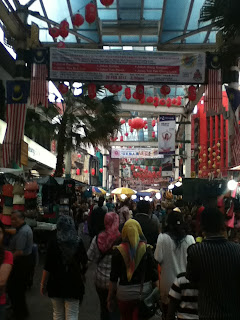
That's how you bargain at Chinatown and Downtown in Kuala Lumpur. The term 'Downtown' might be misleading, it usually refers to the posh areas in top cities. However the 'Downtown' here as it is referred to by locals, offers roadside shopping.
There are three rules to be followed while shopping in these places.
1 .Bargain
2. Bargain more
3. Bargain even more.
Both markets have almost every possible purchasable item known. They draw their own crowd. Shops aren't usually exclusive for one item. There are hundreds of competitors in the same market. Don't write them off, these people are professional in their own way, they are efficient entrepreneurs. They know what works in their business. For instance, just as it began to pour, as I started running to my car, calling out to me was a shopkeeper, "Umbrella for 20 MR. Bargain-able!", the interesting fact being the shopkeeper saying that he is open to a bargain even before the customer reacts.

Chinatown is the Malaysian home for 'Made in China' goods. One doesn't need an explanation for what holds in store there. It is the workplace of hundreds of vendors (who smoke as they work). "Now beware of the sellers here" a local friend of mine had warned. The sellers take to the knife if a purchase is not made after a long bargain!

Downtown offers a comparable experience in a slightly different way. It is a good example of the night life prevailing there. Shops open around 8 in the night and go on till 3 or 4 the next morning depending on the crowd. Couples walk in hand in hand at midnight.  The vendors here mostly work part time. Shops are set up in identical tents but they are distinct on the inside. These vendors are comparitively less aggressive, they don't hide knives.


"Each purchase is an act of mutual understanding between the customer and the vendor. The vendor clearly knows that he over-quotes his item, so does the customer realise that. The initial rates are similar to the ones quoted by Tamil Nadu auto-men to foreign tourists. Exorbitant."

In Chinatown, calculators break the language barrier. Conversations with vendors bear only numbers. A calculator can help accomplish that. So this is how you go, you first point at the desired item. The vendor types in a number (his initial quote in Ringgits) on the calculator and hovers his hand over the 'minus symbol' suggesting a prospective bargain, a definite bargain. You press the minus symbol and make the desired reduction in rate. If my observation is anything to go by, typical bargains end somewhere lesser than midway between the customer and the vendor, the consumer being on the left. This is how an unsuccessful bargain went,
"Black bag" <pointing at it>
"That will be 120MR madam." <'madam' being my mother>
"No, one 'twenty'"
"No madam" <nods no and performs a calculation on the calculator 120-35=85> .
<End of conversation>

At the Downtown, bargaining is not an easy task. The old lady at the 'bag store' was headstrong about the 'green bag' costing 30 MR. There was no room for bargain because the bag was 'water proof and made of 100% leather'. She was generous enough to reduce 5MR each for the other bags we purchased.
It is just the place for ladies crazy about shopping. The shops offer highly fashionable stuff in 'striking colours' as preferred by the locals there.
There are the restaurants that stay open till 3am. There are no competitors here, each restaurant offers a specific food item. There is no menu card, the only item available is clearly identifiable. It is hard for a vegetarian to get stuff to eat in there. He/She could get a cup of  'cut guava' for 2MR, and get more to make a meal. Then there are these shops that sell electronic goods. These goods are packed to perfection, replicating the original packaging. 'Beats Audio' for 15MR! No wonder most music-listeners in the city sport one of them.

Chinatown is the more popular of the two, drawing more foreign customers. Downtown is more restricted to the locals. Nevertheless both these places offer distinct yet enjoyable shopping experiences! So don't forget the extra bag when you plan a trip to KL, for it is sure to become full. Happy shopping!

The crowded streets in Chinatown
The tents in Downtown, closed in the day